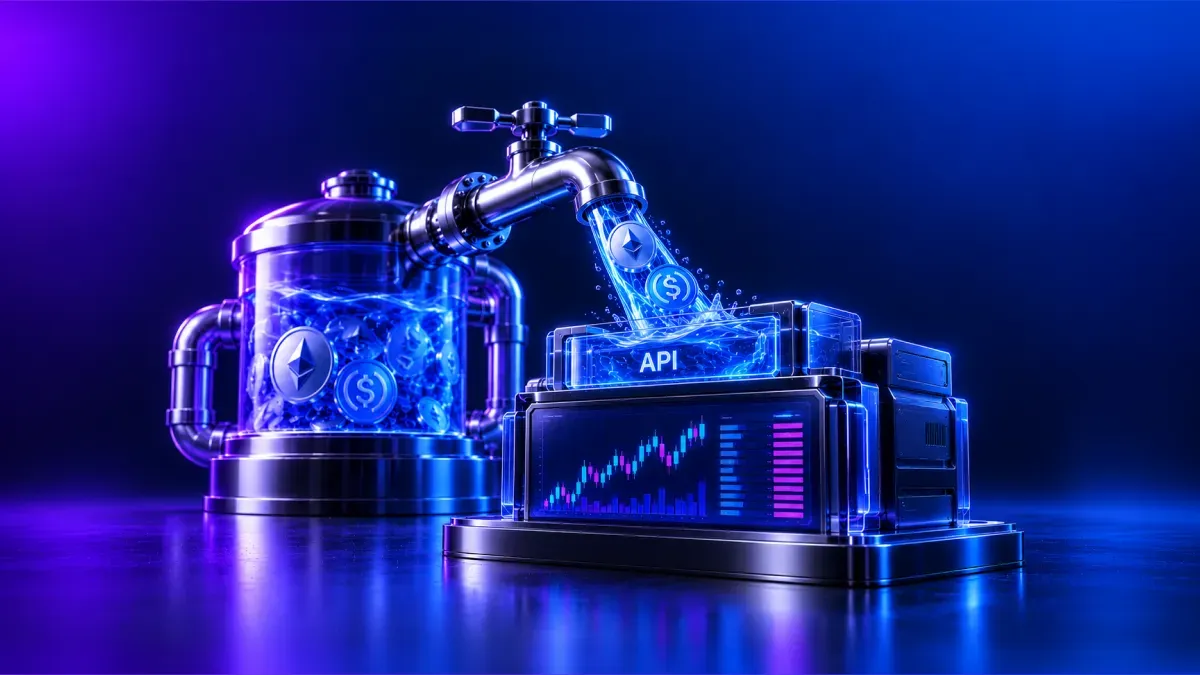


Whether you are new to DeFi or you run an exchange and wonder where depth comes from, this guide is for you. You will learn what a crypto liquidity pool is, how a formula sets its price, how liquidity providers earn, and what can go wrong, with two worked examples.
Key takeaways
- A crypto liquidity pool is a smart contract that holds reserves of two or more tokens so that traders can swap against the pool instead of waiting for another trader to take the other side.
- An automated market maker (AMM) prices each trade with a formula, most often x × y = k.
- Liquidity providers earn fees but face impermanent loss and smart contract risk. Income is never a guarantee.
- Order book exchanges get depth from market makers, not pools.
Not financial advice. Liquidity provision can lose money, so judge it against your own risk tolerance.
What is a crypto liquidity pool?
A crypto liquidity pool is a set of tokens locked in smart contracts that anyone can trade against at a price set by code. Most hold two tokens, such as ETH and USDC. Some keep multiple tokens in a single pool.
The users who fund it are called liquidity providers, or LPs. They deposit crypto assets, and those reserves fill every trade. No company holds the funds, and the rules sit in public token contracts.
Why decentralized exchanges need pools
Decentralized exchanges need pools because no central party matches buyers and sellers. A decentralized liquidity pool always takes the other side, so users never wait for a matching order.
Pools play a crucial role in decentralized finance (DeFi): lending and other DeFi applications rely on them for crypto market liquidity. Funding a pool also gives new crypto assets instant depth and easier trading. Our DEX vs CEX comparison covers both exchange models.
How liquidity pools work
Liquidity pools work in three steps: providers deposit two assets, the pool issues LP tokens as a receipt, and users trade one token for the other at the formula's price.
Deposit and LP tokens
To provide liquidity, you deposit two tokens of equal value. With ETH at $2,000, that could be 1 ETH and 2,000 USDC. Adding liquidity in the same proportion as the reserves leaves the price unchanged.
In return, you receive LP tokens that record your share. Supply 1% of the reserves and you can later redeem 1% of whatever the liquidity pool then contains.
Swaps and how the price moves
Every trade changes the reserves, and the reserves set the price. When users buy ETH with USDC, the pool holds more USDC and less ETH, so ETH costs more for the next buyer. Arbitrage then pulls the pool back toward wider markets.
Automated market makers (AMM) explained
Automated market makers are the pricing programs inside liquidity pools. They replace the order book with a formula, so a trade needs only enough reserves, not a counterparty.
The constant product formula (x × y = k)
The constant product formula says the two reserves, x and y, multiplied together must equal the same constant k after every trade.
Take a pool with 10 ETH and 20,000 USDC. The price is 2,000 USDC per ETH, and k is 10 × 20,000 = 200,000. You send in 2,000 USDC:
- The pool now holds 22,000 USDC.
- To keep k, ETH falls to 200,000 / 22,000 = 9.091.
- You receive 10 − 9.091 = 0.909 ETH, not 1 ETH.
You paid about $2,200 per ETH, 10% above the expected price. The liquidity pool now quotes 22,000 / 9.091, or about $2,420. The example ignores the swap charge.
Slippage and pool depth
Slippage is the gap between the price you expected and the price you got. It grows with trade size and shrinks with depth.
Run the same trade in a pool 100 times larger, with 1,000 ETH and 2,000,000 USDC. Your 2,000 USDC now buys 0.999 ETH. Low liquidity is why small tokens show sharp price moves on many DeFi platforms.
AMM types
AMM designs differ in the curve they use:
- Constant product. The model above. It works for any pair of assets.
- Stable-asset curves. Curve Finance's StableSwap blends constant sum and constant product formulas. It is built for stablecoins and other stable assets, with lower slippage as the design goal (Curve documentation, 2026).
- Concentrated liquidity. Providers pick a price range where their capital works.
How liquidity providers earn
Liquidity providers earn a share of what each trade pays, and sometimes extra token rewards. Both depend on pool activity.
Trading fees
Each swap pays a small charge to the liquidity pool. These trading fees are distributed proportionally to each provider's share.
In Uniswap v2, every pool charges a flat 0.30%. Uniswap v3 has standard tiers of 0.05%, 0.30%, and 1%, and v4 removes fixed tiers so pool creators set the rate (Uniswap documentation, 2026).
Liquidity mining and yield farming
Liquidity mining means a protocol pays extra rewards, usually in its native token, to users who provide liquidity to chosen pools.
With yield farming, you stake LP tokens in another contract to earn rewards on top of swap income. Each layer adds smart contracts that can fail.
Do liquidity pools make money?
Liquidity pools can make money for providers, but there is no guarantee. Income comes from swap charges and incentive rewards. Losses come from impermanent loss, falling token prices, and contract failures.
Marketing often calls pools passive income, which hides the risks involved. High trading volume and stable prices tend to reward providers. A volatile pair can leave you with less than holding.
Risks of liquidity pools
The main risks are impermanent loss, smart contract bugs, rug pulls, and network costs.
Impermanent loss: a worked example
Impermanent loss is the gap between the value of your pool share and the value of the same tokens held in a wallet.
You provide liquidity of 1 ETH and 2,000 USDC with ETH at $2,000, a $4,000 stake. ETH then rises to $8,000. The formula rebalances your share to 0.5 ETH and 4,000 USDC, worth $8,000. Holding both assets would have left you with $10,000.
The gap is $2,000, or 20%. Had ETH only doubled, it would be about 5.7%. The loss shrinks if the ratio returns to its starting point.
Smart contract bugs, rug pulls, and gas fees
A bug in smart contracts can drain the reserves, and an audit lowers that chance without removing it.
In a rug pull, a token's creators withdraw the liquidity and holders cannot sell. Gas fees matter too: on a busy network, the cost to deposit and withdraw can exceed what a small position earns.
- Impermanent loss. How it happens: the price ratio of the two assets changes. Who bears it: liquidity providers. How to reduce it: choose correlated pairs.
- Smart contract bug. How it happens: a code flaw is exploited. Who bears it: providers and users. How to reduce it: prefer audited protocols.
- Rug pull. How it happens: creators pull liquidity or misuse permissions. Who bears it: holders and providers. How to reduce it: check locked liquidity and ownership.
- Gas costs. How it happens: network congestion. Who bears it: all users. How to reduce it: transact less often.
What are the best liquidity pools for crypto?
The best liquidity pools are those that fit your assets and risk tolerance, so no ranking holds for long. Compare any liquidity pool on four criteria:
- Depth. More reserves mean less slippage on each trade.
- Volume. Income comes from activity, not size alone.
- Pair type. A volatile token paired with a non-volatile stablecoin carries more impermanent loss than two stablecoins.
- Protocol record. Check audits, age, and past incidents.
Uniswap v4 went live on January 31, 2025 and added hooks for custom pool logic (Uniswap Labs, 2025). Curve Finance, noted above, focuses on stable assets. Neither is a ranking of the best liquidity pools.
How to check the liquidity pool of a coin
To check a coin's liquidity pool, open its pair on a DEX analytics page and read four figures:
- Depth: the value of tokens locked in the pool.
- Volume: how much traded in the last 24 hours.
- LP count: how many wallets supply the reserves.
- Concentration: whether one wallet owns most LP tokens.
Thin reserves and one dominant provider are a warning sign for new traders.
Can the IRS see your crypto wallet?
Partly, yes. Public blockchains are open to anyone, and US brokers must report sales made through your account on Form 1099-DA for transactions on or after January 1, 2025 (IRS, 2026). The federal return also asks about digital assets.
Liquidity pools vs order books
A liquidity pool prices each trade with a formula, while an order book matches bids and asks from buyers and sellers.
- Pricing. Liquidity pool: a formula based on reserves. Order book: the best bid and ask.
- Who provides liquidity. Liquidity pool: anyone who deposits tokens. Order book: market makers and other users.
- Slippage. Liquidity pool: depends on pool depth and trade size. Order book: depends on order depth.
- Typical venue. Liquidity pool: decentralized trading protocols. Order book: centralized exchanges.
- Main risk. Liquidity pool: impermanent loss and contract bugs. Order book: counterparty and custody risk.
What this means for exchanges
Pools and order books solve one problem differently. A liquidity pool needs locked capital and accepts formula pricing. An order book needs centralized market makers that quote both sides and keep spreads tight.
Large cryptocurrency trading venues run order books, where financial institutions expect firm quotes and low exchange fees. Market makers supply those quotes.
Many platforms also aggregate quotes from several venues. See why crypto market liquidity matters and how to find a crypto liquidity provider.
How SimplifyLabs helps
If you run your own exchange or payment product, you need depth from day one without funding pools yourself. SimplifyLabs offers a managed infrastructure layer for crypto businesses with access to aggregated crypto liquidity across major exchanges and OTC desks through a single API. The same environment covers matching, netting, settlement, and AML screening. Where licensing is required, SimplifyLabs works with trusted partners.
Frequently asked questions
What is an LP token?
An LP token is a receipt that records your share of a liquidity pool. You receive it when you deposit and return it when you withdraw. Its value follows the reserves, so it changes as prices move. Some DeFi platforms let users stake them for extra rewards.
What is impermanent loss?
Impermanent loss is the difference between the value of your pool share and the value of the same tokens held outside it. It appears when the price ratio of the two assets changes. For example, a fourfold rise in ETH leaves a provider about 20% behind holding.
What is an automated market maker?
An automated market maker is a program that prices each trade with a formula, with no order book. The best known formula is x × y = k, where the product of the two reserves stays constant, so each trade moves the price.
Are liquidity pools safe?
Liquidity pools are not risk free. Audited protocols lower the chance of a contract failure but do not remove it. Providers also face impermanent loss, and unknown tokens can turn out to be rug pulls. Only deposit funds you can afford to lose.
Do liquidity pools make money?
They can, but no return is certain. Providers in a liquidity pool collect a share of swap charges and sometimes extra token rewards. Those gains can be smaller than impermanent loss or a drop in token prices. Results depend on volume and volatility.
What is the difference between a liquidity pool and an order book?
A liquidity pool fills each trade from shared reserves at a formula price. An order book matches individual orders from buyers and sellers at prices they choose. Pools are common across the DeFi ecosystem, while order books dominate most centralized exchanges.