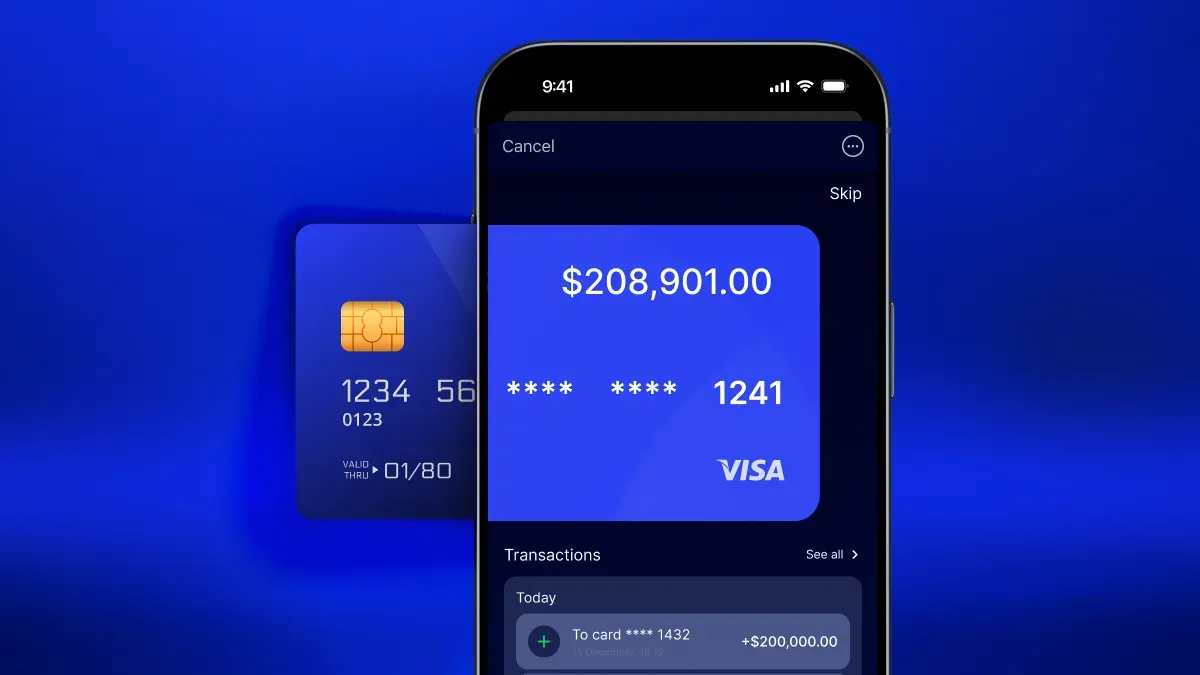


Want to put your own card in your customers' hands without building a bank? This guide explains white-label issuing for fintechs, crypto platforms, and brands. You will learn what it is, the benefits, how a program launches, and exactly what to look for in a partner. By the end, you can decide whether issuing your own branded cards fits your roadmap and how to move fast.
Ready to explore a branded program? See our white-label crypto cards for the product view.
Key takeaways
- White-label issuing lets you launch payment cards under your own brand, while a licensed partner runs the banking, compliance, and processing behind the scenes.
- You can issue branded debit cards, prepaid cards, or crypto cards without building rails or holding a banking license yourself.
- A white-label card program typically goes live in 4 to 8 weeks, versus 12 to 24 months to build alone (ConnectPay, 2026).
- The issuing bank stays invisible to your users, so the card looks and feels like your own product.
- Private-label cards are projected to reach roughly 8.5 billion of nearly 30 billion cards in circulation by 2028 (Airwallex, 2025).
What is white-label card issuing?
White-label issuing is a model where a licensed provider issues payment cards that carry your brand, not theirs. You design the card and own the customer relationship, while the partner handles the license, compliance, and transaction processing. To the end user, the card looks entirely like your product.
This is how most modern fintechs ship cards. The provider supplies the rails through a BIN sponsor and an issuing bank, so you skip the cost and delay of becoming a regulated issuer. For a broader primer on the mechanics, see card issuing explained.
Benefits of white-label card programs
The main benefit of white-label issuing is speed to market at a fraction of the cost of building your own infrastructure. You launch a branded product in weeks, not years, and avoid the capital and licensing burden of independent issuance. That frees your team to focus on users and growth.
The gains go beyond speed. A branded card keeps your name in the customer's wallet, which strengthens loyalty and retention. Each transaction can earn interchange, creating a new revenue stream that can make a card program self-funding at scale. You also gain transaction data and the ability to add tailored rewards.
White-label solutions let you customize the card features that matter to your audience. You control the design, spending rules, and rewards, while the provider manages the regulated parts. This balance is why white-label solutions have become the default path for launching financial products.
How a white-label card program is launched
A white-label card program typically launches in 4 to 8 weeks because the heavy infrastructure already exists. Instead of building from scratch over 12 to 24 months, you plug into a provider's card issuing platform and configure your product. The provider's BIN sponsor and issuing bank carry the regulatory weight.
The path follows a clear sequence. You define the card type and features, complete onboarding and compliance setup, integrate the API, and approve the card design. Virtual cards can go live almost instantly, while physical cards add time for production and shipping.
Through the process, operational duties like compliance and transaction processing sit with the issuing partner. You keep control of branding, pricing, and the customer experience. That division of labor is what makes a fast launch possible.
Technology and compliance
White-label issuing runs on APIs that connect the card program to your existing systems. Modern card issuing providers offer plug-and-play APIs, so your developers can create, freeze, and manage cards in real time without rebuilding payment logic. A sandbox lets you test the full flow before going live.
Security and compliance are built in, not optional. Any credible card program must meet PCI DSS standards, and providers add tokenization so cards work in digital wallets like Apple Pay and Google Pay. The issuing partner also handles KYC, AML, and fraud monitoring, which keeps the compliance burden off your team.
White-label prepaid cards
White-label prepaid cards let you issue branded cards that customers load with funds before spending. They suit loyalty programs, payouts, gifting, and budgets, since the balance is fixed and easy to control. A white-label prepaid card can also issue instantly as a virtual card and sit in digital wallets.
Prepaid programs carry a few extra advantages for brands. They capture valuable customer data, support tailored rewards, and work without a customer needing a traditional bank account. For many businesses, prepaid cards are the simplest entry point into white-label issuing.
Debit vs prepaid vs crypto: which white-label card to launch
The right card type depends on your funding source and audience. Debit cards draw from a linked account, prepaid cards use a loaded balance, and crypto cards spend digital assets converted to fiat at checkout. Use the table to match a type to your use case.
| Card type | Funding | Launch speed | Best for |
|---|---|---|---|
| Debit cards | Linked account balance | Fast | Neobanks, payroll, gig payouts |
| Prepaid cards | Pre-loaded funds | Fastest | Loyalty, gifting, budgets |
| Crypto cards | Crypto converted to fiat | Fast | Wallets, exchanges, Web3 brands |
Many brands start with prepaid cards or debit cards for simplicity, then add crypto as they grow. Flexible white-label solutions let you run more than one type from a single platform.
What to look for in a white-label issuer
Choose a white-label issuer the way you would choose any core card issuing partner: on coverage, speed, and trust. The right partner removes friction instead of adding it, so weigh these factors before you sign.
- Licensing and BIN sponsorship. Confirm the provider supplies a licensed issuing bank or BIN sponsor for your target regions.
- Compliance coverage. Check for PCI DSS compliance, plus built-in KYC, AML, and fraud monitoring.
- Speed to launch. Ask for a realistic timeline; strong partners ship in 4 to 8 weeks.
- API quality. Look for clean, documented APIs, a sandbox, and webhooks for real-time control.
- Card types and funding. Make sure they support the debit cards, prepaid cards, or crypto cards you plan to issue.
- Wallet and design support. Confirm Apple Pay tokenization and full control over card design.
- Pricing model. Understand setup fees, monthly costs, and per-card or transaction fees, and how interchange is shared.
A provider that checks these boxes lets you launch your own cards with confidence and scale without surprises.
How SimplifyLabs helps
SimplifyLabs offers white-label card programs built for fintech and crypto brands that want their own cards without becoming a bank. You launch branded debit cards, prepaid, or crypto cards with instant issuance, real-time controls, tokenization for Apple Pay and Google Pay, and inherited compliance. Cards can be funded by fiat or crypto, which fits crypto-native products.
This post is educational, and SimplifyLabs is one route among many. If a branded program fits your roadmap, explore our white-label crypto cards, or see how a crypto payment gateway pairs with issuing to complete your stack.
Frequently asked questions
What is white-label issuing?
White-label issuing is a model where a licensed provider issues payment cards under your brand. You own the design and customer relationship, while the partner handles the license, compliance, and processing. The issuing bank stays invisible to your users, so the card feels like your own product. It lets brands launch cards without building banking infrastructure.
How long does it take to launch a white-label card program?
A white-label card program typically launches in 4 to 8 weeks, compared to 12 to 24 months to build your own infrastructure (ConnectPay, 2026). Virtual cards can go live almost instantly once compliance and integration are complete, while physical cards add time for production and shipping. The exact timeline depends on your region, card type, and integration complexity.
What does the white-label issuer handle versus the brand?
The issuer handles the regulated and technical work: the banking license, BIN sponsorship, compliance, fraud monitoring, and transaction processing. The brand handles the parts customers see, including card design, pricing, rewards, and the user experience. This split lets you launch a branded card program quickly while a licensed partner carries the settlement and regulatory risk.
How much does white-label issuing cost?
Costs vary by provider and program, so there is no single price. Most charge a setup fee, a monthly platform fee, and per-card or transaction fees, and many share interchange revenue. Building your own issuing infrastructure instead can cost far more and take 12 to 24 months. Ask each partner for a full fee breakdown before you commit.
Debit, prepaid, or crypto: which should I launch first?
Start with the card type that matches your funding source and users. Prepaid cards are the simplest entry point and suit loyalty and payouts. Debit cards fit neobanks, payroll, and gig platforms that fund from account balances. Crypto cards suit wallets and exchanges whose users want to spend digital assets. Many brands launch one type, then add others.
Do I need a banking license for white-label issuing?
No, you do not need your own banking license. The white-label provider's BIN sponsor or issuing bank holds the license and network membership, so you can issue branded cards under their regulatory cover. You still need your own KYC and AML policies, but the heavy licensing work sits with the partner. This is what makes a fast launch possible.
Reviewed by the SimplifyLabs Payments Team. Last reviewed: 2026-06-30. This article is for general information and is not financial or legal advice. Timelines, fees, and availability vary by provider and region.