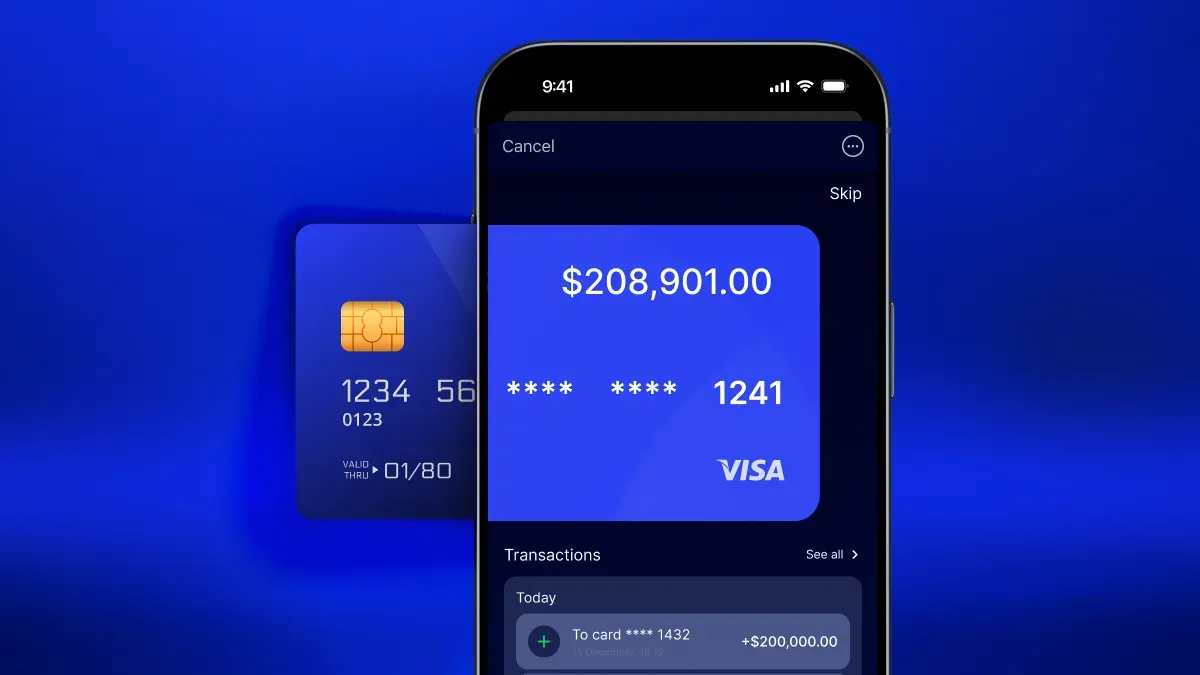


A business virtual card is a payment card number issued in software to a person, a team, a vendor, or a single transaction. It draws on company funds, carries controls set by finance, and can be created in seconds and killed just as fast.
For most companies the shift from shared plastic cards to virtual issuance is less about convenience than about control. When every subscription, campaign, and supplier payment runs on its own card with its own limit, spend becomes visible as it happens rather than at month-end — and the reconciliation work that used to consume a finance team's closing week largely disappears.
The Problem Business Virtual Cards Solve
Most companies arrive at virtual cards after outgrowing one of a few common arrangements:
- The shared company card. One number circulated among staff. Nobody can tell who spent what, a single compromise forces reissuance across every vendor, and departure of a key employee means updating dozens of billing profiles.
- Reimbursement. Employees and contractors pay personally and claim back. It pushes cash-flow strain onto individuals and makes spend visible only after it is committed.
- Cards per employee, no controls. Better attribution, but policy exists only as a document. Enforcement is retrospective and awkward.
- Bank transfer for everything. Slow, poorly suited to online vendors, and offers no dispute mechanism comparable to a card chargeback.
Virtual cards address all four by making each card cheap enough to be disposable and specific enough to be controlled.
How Businesses Use Virtual Cards
Software and Subscriptions
One card per SaaS vendor, capped at the expected monthly charge. Renewal price increases are caught at the point of authorisation rather than discovered on a statement. When a tool is cancelled, the card is deleted, which removes the familiar problem of a forgotten subscription billing for another year.
Advertising and Media Buying
Ad platforms can consume budget quickly, and a compromised account is an expensive incident. A dedicated card with a hard ceiling caps the exposure regardless of what happens inside the platform. Separate cards per campaign or per channel also give clean cost attribution without relying on the platform's own reporting.
Vendor and Supplier Payments
Rather than storing one company card with every supplier, finance issues a card per vendor. Some programmes go further and issue a single-use card per invoice, matched to the exact amount, which eliminates duplicate and overbilling entirely. The card cannot be charged twice because it ceases to exist after the first authorisation.
Employee and Team Spend
Cards issued per person or per team with limits reflecting their actual authority. Sales gets a travel and entertainment card, engineering gets a cloud infrastructure card, marketing gets an events card — each with its own ceiling and merchant rules.
Contractors and Agencies
Project-scoped cards that expire when the engagement ends, removing the need to chase people for expense claims or collect plastic on the last day.
Travel
A card per trip, funded to the approved budget, active only for the travel dates and only in the destination country. Booking, accommodation, and ground costs all attribute to that trip automatically.
Controls Available on Business Cards
Control
Effect
Common Application
Spend limit
Caps total or per-transaction amount
Match card to approved budget
Merchant lock
Card works at one named merchant only
One card per SaaS vendor
Category rules
Permits or blocks merchant category codes
Block cash advance and entertainment
Single-use
Card expires after one authorisation
Invoice-matched supplier payments
Time-bounded
Active only within a date range
Project and trip cards
Geographic rules
Restricts by merchant country
Travel and regional programmes
Approval workflow
Requires sign-off above a threshold
High-value or exceptional spend
Instant freeze
Disables the card immediately
Offboarding, suspected fraud
The critical property is that these apply at authorisation. A transaction breaching policy is declined by the issuer in real time, not flagged in a report afterwards. Policy becomes a technical constraint rather than an expectation.
Virtual Cards Versus Corporate Credit Cards
Dimension
Business Virtual Cards
Traditional Corporate Card
Issuance time
Seconds
Days to weeks
Cards per company
Effectively unlimited
Limited, often per employee
Granular controls
Per card, configurable
Coarse, often just a limit
Attribution
Automatic per card
Manual coding
Funding
Usually company-funded debit or prepaid
Credit line
Credit check
Usually none
Company underwriting, sometimes personal
Rewards
Limited or none
Points, cashback, travel benefits
Float
None — funds drawn immediately
Interest-free period until statement
The trade-off is real: corporate credit cards offer working-capital float and rewards that debit-funded virtual programmes generally do not. Many companies run both, using a credit facility for large predictable costs and virtual cards for the long tail of distributed spend where control matters more than float.
Reconciliation and Accounting
The finance benefit is structural rather than incremental. Because each card is scoped to a vendor, project, or trip, the general ledger coding is determined at issuance rather than reconstructed afterwards. A card created for a specific client project carries that tag on every transaction it ever authorises.
Most platforms then sync transactions to accounting software with the tag, category, and attached receipt, so month-end becomes a review of exceptions rather than a data entry exercise. Receipt capture is typically prompted at the moment of authorisation, and cards can be automatically restricted where documentation remains outstanding — considerably more effective than reminder emails.
Security Considerations
- Blast radius is contained. A compromised card affects one vendor relationship, not every service the company pays for.
- Offboarding is instant. Cards tied to a departing employee are killed immediately, with no dependency on returning plastic.
- Vendor breaches are survivable. A merchant-locked number stolen from a supplier's systems is unusable elsewhere.
- Fraud is bounded by design. A card capped at its expected monthly charge limits any incident to that amount.
- Access control still matters. The platform dashboard becomes a sensitive system. Enforce multi-factor authentication and role-based permissions.
Choosing a Provider
For a side-by-side look at named vendors rather than criteria alone, see top virtual card providers for business.
- Card volume economics. If issuing hundreds of cards, per-card fees dominate. Confirm whether card creation is metered.
- Control granularity. Merchant locking and single-use issuance are the features that create real leverage. A spend cap alone is weak.
- Accounting integration. Native sync to your ledger with tags and receipts preserved, not a CSV export.
- Country and currency coverage. Where can cards be issued, in what currencies, and at what conversion cost.
- Wallet provisioning. Apple Pay and Google Pay support if any spend happens in person.
- API access. Essential if you want to issue cards programmatically from your own systems — see card issuing API for what that integration actually involves.
- The underlying issuer. Which licensed institution issues the cards, in which jurisdictions, and how funds are safeguarded — this is usually a BIN sponsor rather than the platform itself.
- Funding flexibility. Bank transfer, direct debit, or — for crypto-native businesses — stablecoin funding. Providers such as SimplifyLabs run white-label programmes of the latter type for platforms operating outside conventional banking coverage.
Rollout in Practice
- Map current spend. Identify what is on shared cards, personal cards, and bank transfers, and who authorises each.
- Start with vendors, not people. Migrating recurring software and supplier payments to dedicated cards delivers the clearest early win and involves no behaviour change.
- Define the control template. Decide default limits and merchant rules per spend category before issuing broadly.
- Connect accounting first. Set up the ledger sync before scaling card count, or you will migrate historical data later.
- Extend to teams. Roll out per-person and per-project cards once the vendor layer is stable.
- Review quarterly. Unused cards, limits that no longer match reality, and dormant subscriptions surface easily when each has its own card.
Frequently Asked Questions
What is a business virtual card?
A payment card number issued in software rather than plastic, drawing on company funds and carrying controls such as spend limits, merchant restrictions, and expiry dates. Merchants process it exactly like any other card.
Do virtual cards work everywhere?
For online payments, effectively yes. For in-person payments they need to be added to a mobile wallet. Some merchants — notably car hire and certain hotels — may require a physical card at collection.
How many virtual cards can a company issue?
Most platforms impose no practical limit, though per-card fees may apply. Companies commonly run from dozens to thousands depending on how granularly they scope cards.
Are business virtual cards credit or debit?
Most are debit or prepaid, drawing on a company-funded balance. Some providers offer credit-backed virtual cards, but the majority of spend-management platforms are funded rather than lending.
Can virtual cards be used for recurring payments?
Persistent virtual cards are well suited to subscriptions and arguably better than a shared plastic card, since each vendor gets its own capped number. Single-use cards cannot be used for recurring billing.
How do virtual cards improve reconciliation?
Because each card is scoped to a vendor, project, or trip, coding is determined when the card is created rather than reconstructed at month-end. Transactions arrive in the ledger already categorised.
What happens when an employee leaves?
Their cards are frozen or deleted immediately from the dashboard. Nothing needs to be physically returned, and no vendor billing profiles need updating if cards were scoped per vendor rather than per person.
Are virtual cards secure enough for large payments?
Yes, and often more secure than alternatives. A single-use card matched to an invoice amount cannot be charged twice or for a different sum, which is stronger protection than a standing card number held on a supplier's file.