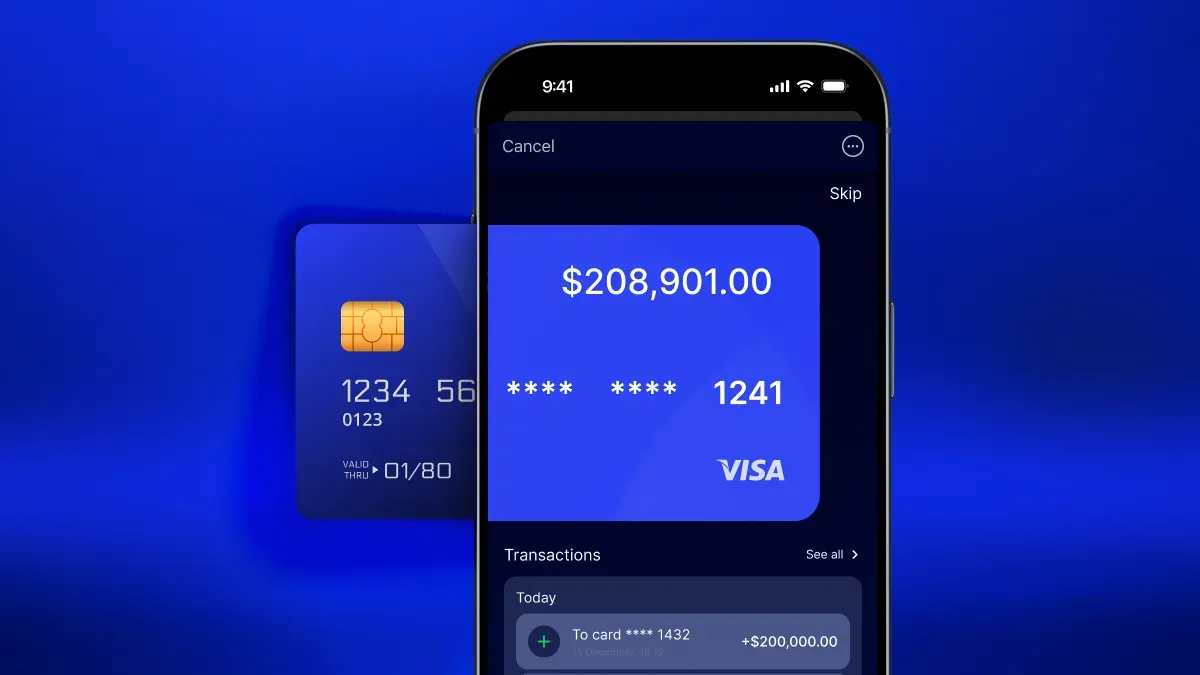


A virtual debit card is a card number that exists only in software. There is no plastic, no delivery wait, and no physical object to lose. It draws on a funded account exactly as a conventional debit card does, and merchants process it identically — they cannot tell the difference.
The category has expanded quickly, and the options now range from a free feature bundled into a bank app to specialised products built for privacy, travel, or business spending. Because "best" depends entirely on what you need the card for, this guide sets out the evaluation criteria that actually differentiate products, rather than ranking brands whose fees and availability change constantly.
What a Virtual Debit Card Is
A virtual debit card consists of the same four elements as any card: a 15- or 16-digit number, an expiry date, a security code, and a cardholder name. It is generated on demand and delivered into an app or dashboard, usually within seconds. Funds come from a linked account or a prepaid balance.
Because the number is generated in software rather than embossed on plastic, it can be treated as disposable. Many providers allow you to create a card for one merchant, one transaction, or one billing cycle, then discard it. That disposability is the source of most of the security benefit.
Virtual, Physical, and Tokenised Cards
Type
How It Works
Best For
Physical card
Plastic card with chip and contactless
In-person payments, ATM access
Virtual card
Software-generated number, no plastic
Online purchases, subscriptions, trials
Tokenised card
Device-specific token in a mobile wallet
In-store contactless via phone or watch
These are not mutually exclusive. Many accounts provide a physical card, unlimited virtual numbers drawing on the same balance, and wallet tokenisation for in-person use.
The Criteria That Actually Matter
1. Who Issues It
The most important question, and the one most often skipped. Behind every virtual card is a licensed issuing institution — a bank or, in many markets, an e-money institution. That entity determines whether your funds are protected, which jurisdictions the card can serve, and what happens if the provider fails.
Check who the issuer is, where it is licensed and regulated, and how customer funds are held. Deposit-based accounts are typically covered by a deposit guarantee scheme up to a statutory limit. Funds held by an e-money institution are usually safeguarded — segregated from the firm's own assets — which is protective but works differently from deposit insurance. A provider unwilling to state plainly who issues its cards is a provider to avoid.
2. Card Creation Model
Providers differ substantially here, and it drives how you can use the product:
- Single virtual card. One number tied to the account. Convenient, but offers no more compartmentalisation than a plastic card.
- Multiple persistent cards. Several numbers you can create and keep, typically one per merchant or category.
- Single-use cards. The number expires after one transaction. Strong protection for one-off purchases from unfamiliar sites.
- Merchant-locked cards. The number only authorises at the merchant that first used it. If the details leak, they are worthless anywhere else.
Merchant locking is the single most valuable feature for most users, and its availability varies widely.
3. Fee Structure
Advertised as free, virtual cards often carry costs in less visible places. Look for:
- Monthly or annual account fees, and whether a free tier limits card count
- Per-card creation fees, which matter if you create many
- Foreign exchange margin — commonly the largest real cost, expressed as a percentage over the interbank rate
- Top-up fees, which vary sharply by funding method
- Inactivity fees on prepaid balances
- Withdrawal or transfer-out charges
For anyone spending internationally, the FX margin usually dwarfs every other fee. A card advertising no monthly cost but applying a three percent conversion margin is expensive for a frequent traveller and cheap for someone who only buys domestically.
4. Funding and Currency Support
How you load the card determines how usable it is. Consider whether it accepts bank transfer, card top-up, direct salary deposit, or crypto conversion, and how long funds take to become available. Multi-currency support matters if you hold or spend in more than one currency: a card that holds balances in several currencies and spends from the matching one avoids conversion entirely.
5. Availability in Your Country
Card issuing is licensed territorially. A well-reviewed product may simply not be available where you live, or may be available with a reduced feature set. Verify eligibility for your country of residence before investing time in an application.
6. Wallet and Subscription Compatibility
Confirm the card can be added to Apple Pay or Google Pay if you want in-person use. Also consider recurring payments: single-use cards break subscriptions by design, so a provider offering only single-use numbers is unsuitable for anything billed monthly. Some merchants and rental or hotel systems also reject virtual numbers where a physical card must be presented at collection.
7. Controls and Visibility
Useful features include per-card spend limits, instant freeze and unfreeze, real-time transaction notifications, and the ability to view full card details securely in-app. For shared or family use, the ability to issue subordinate cards with independent limits is worth checking.
Matching the Card to the Use Case
If you mainly want to...
Prioritise
Protect against merchant data breaches
Merchant-locked and single-use card generation
Manage free trials and subscriptions
Persistent per-merchant cards with hard spend caps
Spend abroad
Low FX margin, multi-currency balances, wallet support
Control business or team spend
Multi-user issuance, approval rules, accounting export
Spend a crypto balance
Real-time conversion, transparent conversion pricing
Reduce exposure on unfamiliar sites
Instant single-use cards at no per-card cost
For business and team spend in depth, see business virtual cards; for named vendors compared side by side, see top virtual card providers.
Security: What Virtual Cards Do and Do Not Solve
Virtual cards genuinely reduce certain risks. If a merchant is breached and card data is stolen, a merchant-locked number cannot be used elsewhere, and a single-use number is already dead. Your primary card number is never exposed, so a compromise does not force you to reissue the card every other service bills against.
They do not solve everything. A virtual card can still be charged by the merchant it is locked to, so an unauthorised recurring charge from a legitimate merchant remains possible. They do not protect against phishing that captures your account login rather than card details. And they do not change the underlying dispute process — a fraudulent transaction still has to be raised with the issuer.
Statutory cardholder protections against unauthorised transactions generally apply to virtual cards on the same terms as physical ones, since the legal category is the payment instrument rather than its form factor. Confirm this with your provider, particularly for prepaid products, where protections can differ from those attached to a bank account.
Common Mistakes
- Choosing on headline fees alone. The FX margin and top-up costs usually determine the real price.
- Using single-use cards for subscriptions. The renewal fails and the service is cut off.
- Assuming universal acceptance. Car hire, hotels, and some age-restricted merchants may require a physical card.
- Ignoring the issuer. The provider's app is not the institution holding your money.
- Leaving large balances on prepaid cards. Prepaid balances may carry different protections than bank deposits, and inactivity fees can erode them.
Frequently Asked Questions
Are virtual debit cards safe?
Generally safer than physical cards for online use, because the number can be locked to one merchant or destroyed after a single transaction. The safety of your funds depends on the licensed issuer behind the card rather than the card format itself.
Can I use a virtual debit card in a shop?
Only if it can be added to a mobile wallet such as Apple Pay or Google Pay, which lets you pay by phone. Without wallet support, a virtual card is limited to online and telephone transactions.
Can I withdraw cash with a virtual card?
Not directly at an ATM, since there is no card to insert. Some wallet-enabled cards support contactless ATM withdrawal where the machine and issuer permit it, but availability is inconsistent.
Do virtual debit cards work for subscriptions?
Persistent virtual cards work well and are arguably better than a physical card, because you can cap the amount and cancel the number without disrupting anything else. Single-use cards do not work for recurring billing.
Why was my virtual card declined?
Common causes are insufficient balance, a spend limit reached, a merchant lock preventing use elsewhere, a merchant category the provider blocks, or a merchant that specifically rejects prepaid and virtual numbers.
How quickly can I get one?
Card generation itself is usually instant. The delay is account opening, since identity verification is required before any card can be issued — typically minutes to a couple of days depending on the provider and your documents.
Is a virtual debit card the same as a prepaid card?
Not necessarily. Virtual describes the format; prepaid describes the funding model. A virtual card can draw on a bank account or on a prepaid balance, and the distinction affects how your funds are protected.
Can I get a virtual card that spends from crypto?
Yes. Several programmes convert a cryptocurrency balance to fiat at the point of authorisation (see how a cryptocurrency debit card works), so the merchant receives an ordinary card payment. Compare the conversion margin carefully, as it is the main cost and is not always presented clearly alongside the headline fees.