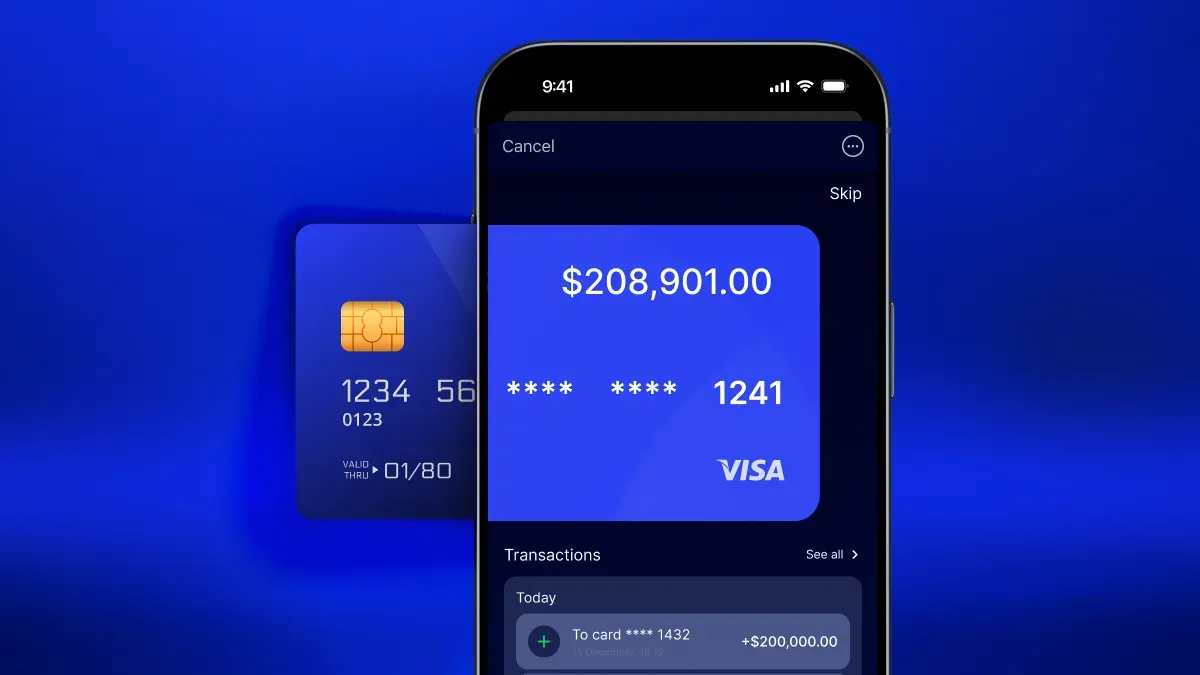


Every payment card in circulation — every debit card, credit card, prepaid card, and virtual card — was issued by a licensed financial institution known as a card issuing bank. The issuing bank is the entity whose name and licence sit behind the card, even when the card carries a fintech brand, a retailer logo, or an airline name on the front.
Understanding what an issuing bank does matters to anyone building a card programme, evaluating payment infrastructure, or simply trying to understand where their money actually sits. This guide covers the role of the card issuer, how it differs from an acquiring bank, how money moves through a card transaction, how issuers earn revenue, and what the BIN sponsorship model means for companies that want to launch cards without becoming a bank themselves.
What Is a Card Issuing Bank?
A card issuing bank is a financial institution licensed by a card network — most commonly Visa or Mastercard — to issue payment cards to cardholders. The issuer holds the cardholder relationship, maintains the account the card draws on, authorises or declines transactions, and carries the financial and regulatory responsibility for the programme.
When a customer taps a card at a coffee shop, the merchant never touches the customer's account. The merchant's bank asks the customer's bank for permission to take the money, and the customer's bank answers. That customer-side bank is the card issuer.
The issuing bank also owns the obligations that come with that relationship: verifying customer identity, monitoring for money laundering, protecting cardholders from unauthorised transactions, and answering to the regulator when something goes wrong. This is why the issuer is always a licensed institution, and why fintechs that want to offer cards must either become one or partner with one.
Card Issuing Bank vs. Acquiring Bank
The two sides of a card transaction are frequently confused. The issuer serves the cardholder; the acquirer serves the merchant. Both are network members, and both take a share of the economics, but their roles are distinct.
Dimension
Issuing Bank
Acquiring Bank
Customer
The cardholder
The merchant
Core function
Issues cards, holds accounts, authorises transactions
Onboards merchants, accepts transactions, settles funds
Money flow
Pays out funds on approved transactions
Receives funds and credits the merchant
Primary risk
Credit risk and cardholder fraud
Merchant default and chargeback exposure
Revenue source
Interchange, cardholder fees, interest
Merchant discount rate, terminal and gateway fees
Dispute role
Raises chargebacks for the cardholder
Defends chargebacks for the merchant
A single institution can perform both roles, and many large banks do. But they are separate licences, separate businesses, and separate risk models.
What a Card Issuing Bank Actually Does
Issues Cards and Owns the BIN
The issuer obtains a Bank Identification Number from the card network — the leading digits of the card number that identify which institution issued it and what type of product it is. Visa historically used six-digit BINs; both Visa and Mastercard have since moved to eight-digit issuer identification numbers to expand available capacity. Every card the issuer produces is numbered within its assigned ranges, which is how the network knows where to route an authorisation request.
Authorises or Declines Transactions
When a transaction is attempted, the issuer decides in real time whether to approve it. That decision weighs available balance or credit line, velocity and spending patterns, merchant category, geography, device signals, and the outputs of a fraud engine. The whole exchange typically completes in well under a second.
Funds the Transaction
On approval, the issuer commits to paying. It places a hold on the cardholder's funds or credit line, then settles with the network, which settles with the acquirer, which pays the merchant. For a credit card, the issuer is extending short-term credit at the point of sale — it pays the merchant before the cardholder pays the bill.
Manages Credit and Fraud Risk
For credit products, the issuer underwrites the customer, sets the credit limit, prices the interest rate, and absorbs losses when balances go unpaid. For debit and prepaid products, there is no credit exposure, but the issuer still carries fraud losses on transactions where the cardholder is protected from liability.
Handles Disputes and Chargebacks
When a cardholder disputes a charge, the issuer represents them. It investigates, provisionally credits the account where required, and raises a chargeback through the network against the acquirer. Consumer protection rules oblige the issuer to act within defined timeframes, which is why disputes are an issuer obligation rather than an optional service.
Owns KYC, AML, and Compliance
The issuer must verify the identity of every cardholder, screen against sanctions lists, monitor transactions for suspicious patterns, and file reports with the relevant financial intelligence unit. It also maintains PCI DSS compliance for cardholder data and adheres to the operating rules of the networks it belongs to. When a regulator examines a card programme, it examines the issuer.
How a Card Transaction Moves Through the Issuer
The mechanics are consistent across nearly every card payment, whether contactless in a shop or one-click online:
- Initiation. The cardholder presents the card. The terminal or checkout page captures the card credentials and transaction amount.
- Routing. The merchant sends the request to its acquirer, which passes it to the card network. The network reads the BIN and identifies the issuer.
- Authorisation. The issuer evaluates the request against balance, limits, and fraud rules, then returns an approval or a decline code.
- Hold. On approval, the issuer reserves the amount against the cardholder's account. The merchant releases the goods or service.
- Clearing. The merchant submits the batch, usually at end of day. The network calculates what each party owes.
- Settlement. The issuer transfers funds to the network, which pays the acquirer, which credits the merchant — typically one to three business days after the sale.
- Posting. The transaction posts to the cardholder's statement. The pending hold converts to a completed debit.
Authorisation and settlement are separate events, which explains a common source of confusion: a transaction can appear as pending on a statement for days, or a cancelled authorisation can leave a hold that disappears without ever becoming a charge.
How Card Issuing Banks Make Money
Issuer revenue comes from several streams, weighted differently depending on the product:
- Interchange. A fee paid by the acquirer to the issuer on every transaction, set by the network. This is the primary economic engine of card issuing. Rates vary by card type, merchant category, and region — and are regulated in some markets. The European Union caps consumer interchange at 0.2% for debit and 0.3% for credit, while the United States caps debit interchange only for larger banks and leaves credit interchange uncapped.
- Interest. On credit products, revolving balances generate interest income, historically the largest revenue line for consumer credit card issuers.
- Cardholder fees. Annual fees, card issuance and replacement fees, foreign exchange margins, cash withdrawal fees, and late payment charges.
- Programme fees. Where the issuer acts as a sponsor for third-party card programmes, it charges setup fees, per-card fees, and a share of transaction economics.
Interchange regulation is the single biggest variable in card programme economics. A programme that is comfortably profitable in the United States can be unviable in the European Union on the same volume, purely because of the cap.
BIN Sponsorship: Issuing Cards Without Being a Bank
Most branded cards are not issued by the company whose logo appears on them. A fintech, exchange, marketplace, or corporate expense platform will typically launch cards through a BIN sponsorship arrangement, where a licensed issuing bank lends its licence and BIN ranges to the programme.
In this model, responsibilities split across three roles that may or may not sit in the same company:
- The issuing bank (BIN sponsor). Holds the network licence and regulatory permissions, owns settlement obligations, and retains ultimate accountability for compliance.
- The processor. Runs the technical infrastructure — authorisation decisioning, card lifecycle management, ledgers, and APIs.
- The programme manager. Owns the customer relationship, brand, product design, and user experience. This is usually the fintech itself.
The alternative is principal membership: applying directly to Visa or Mastercard for a licence in your own right. It offers better economics and full control, but demands regulatory authorisation, substantial capital, settlement capability, and a compliance function to match.
Consideration
BIN Sponsorship
Principal Membership
Time to launch
Weeks to a few months
Twelve months or more
Regulatory burden
Shared with the sponsor
Fully your own
Capital requirement
Low
Substantial
Unit economics
Sponsor takes a share
You retain full interchange
Control over product
Constrained by sponsor policy
Complete
Best suited to
Launching and validating a programme
Established scale volumes
Most card programmes begin with sponsorship and migrate to principal membership only once volume justifies the overhead. Attempting the reverse order is a common and expensive mistake.
Choosing a Card Issuing Partner
Whether selecting a BIN sponsor or an issuer-processor, the evaluation criteria are largely consistent:
- Licensing footprint. Which jurisdictions can the issuer legally serve? Card programmes are territorial, and a sponsor licensed in one region cannot simply extend to another.
- Supported card types. Debit, prepaid, credit, virtual, physical, single-use, multi-currency — not every issuer supports every product.
- API quality. Card issuance, spend controls, real-time transaction webhooks, and balance synchronisation determine what you can actually build.
- Risk appetite. Some issuers will not sponsor programmes touching crypto, gaming, or high-risk merchant categories. Establish this early.
- Economics. Setup costs, per-card fees, transaction fees, interchange share, and minimum volume commitments.
- Wallet support. Apple Pay and Google Pay provisioning is now an expectation rather than a differentiator.
- Operational stability. Authorisation uptime and latency directly determine whether cards work at the till.
Regulatory Obligations of an Issuer
Card issuing is among the more heavily regulated activities in financial services. The specific framework depends on jurisdiction, but the obligations are broadly consistent:
- Authorisation to hold client funds. Typically a banking licence or, in Europe, an e-money institution licence under the relevant payment services framework.
- Customer due diligence. Identity verification, beneficial ownership checks for corporate cardholders, and ongoing monitoring proportionate to risk.
- Anti-money laundering controls. Transaction monitoring, sanctions screening, and suspicious activity reporting.
- Safeguarding. Customer funds must be segregated from the institution's own operating capital.
- Cardholder protection. Statutory limits on cardholder liability for unauthorised transactions and defined dispute resolution timelines.
- Strong customer authentication. In markets including the European Union and the United Kingdom, most electronic payments require multi-factor authentication.
- PCI DSS. Security standards governing the storage, processing, and transmission of cardholder data.
Card Issuing for Fintech and Crypto Businesses
Card issuing has become a standard extension for platforms that already hold customer balances. Exchanges, wallet providers, neobanks, and payroll platforms add cards because it converts a stored balance into something spendable in the physical world — which drives retention, adds a revenue line, and keeps funds on the platform rather than being withdrawn elsewhere.
For crypto businesses specifically, the card sits at the boundary between two systems. The user holds a crypto balance; the merchant accepts fiat. The card programme converts at the point of authorisation, so the merchant receives an ordinary card payment while the user spends from a crypto balance. The complexity sits in the conversion, the balance synchronisation, and the compliance layer — not in the card itself.
Finding a sponsor willing to underwrite crypto-linked programmes remains the practical bottleneck, since many traditional issuers exclude the category outright. Providers such as SimplifyLabs address this by packaging the sponsorship, processing, and compliance tooling into a single white-label programme, which is generally why platforms in this segment work through a specialist rather than approaching banks directly.
Frequently Asked Questions
Who is the issuing bank on my card?
It is usually printed on the front or back of the card, and it appears on your statement. If the card carries a fintech brand, the issuing bank is often named in small print or in the terms and conditions, sometimes with wording indicating the card is issued pursuant to a licence from the network.
Is the card network the issuing bank?
No. Visa and Mastercard operate the networks that route transactions and set the rules, but they do not issue cards, hold accounts, or lend money. Those functions belong to the issuing bank. American Express and Discover are exceptions in some markets, where they act as both network and issuer.
Can a non-bank issue payment cards?
Not independently. A non-bank can operate a card programme and own the entire customer experience, but the card must be issued under the licence of an authorised institution — either a bank or, in jurisdictions that permit it, an e-money institution.
What is the difference between an issuer and an issuer-processor?
The issuer holds the licence and the regulatory responsibility. The issuer-processor provides the technology that runs the programme — authorisation decisioning, card management, and APIs. Some companies do both; many specialise in one.
Why did my issuing bank decline a transaction?
Common reasons include insufficient funds, exceeded limits, fraud rules triggered by unusual geography or merchant type, expired card details, or failed authentication on an online purchase. Issuers deliberately keep decline reason codes vague to merchants, so the cardholder generally has to ask the issuer directly.
How long does it take to launch a card programme?
Through an established BIN sponsor with a ready processing stack, weeks to a few months is realistic. Obtaining your own licence and principal membership typically takes a year or more, with significant capital and compliance investment.
Does the issuing bank hold my money?
For debit and prepaid cards, yes — the funds sit in an account at the issuer or in a safeguarded account it controls. For credit cards, the issuer is lending rather than holding, so no customer balance is involved.
What happens if an issuing bank fails?
Deposit-based accounts are generally covered by the deposit guarantee scheme in the relevant jurisdiction, up to the applicable limit. Funds held under e-money safeguarding rules are segregated from the institution's own assets, though the protection mechanism differs from deposit insurance.